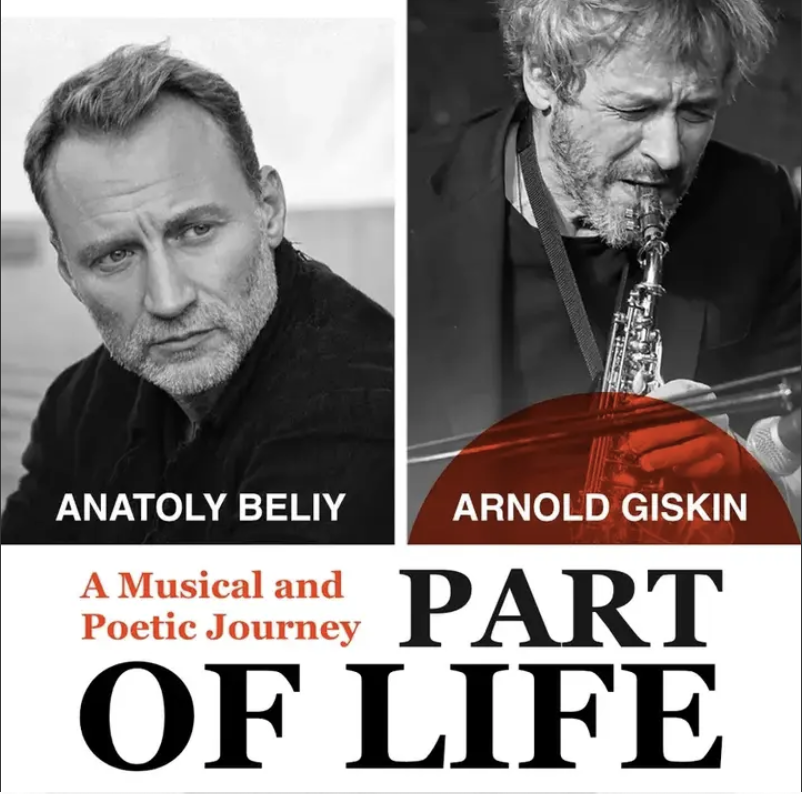
I recently attended a musical poetry performance by the talented actor Anatoly Beliy and the brilliant saxophonist Arnold Giskin, both of whom are internationally renowned.
Although I have attended many poetry readings and artistic performances by artists from various countries over the years, something about this evening felt unique. It would be too simplistic to attribute it to the saxophone that was played by Arnold Giskin, or the poetry read by Anatoly, or even the remarkable skill of both performers. What I felt belonged to an entirely different dimension of experience. A palpable state that enveloped the entire room, that carried both the artists and the audience into an extraordinary space beyond ordinary perception.
The ability to create such resonance does not happen from performance alone. Technical mastery can move people, but what I witnessed was coming from a deeper source.
Curious about the experience, I later asked Anatoly what he feels during his performances. His response was simple, brief, but profound. He explained that when he reads poetry, his soul rejoices. Something inside him begins to shine, and he feels happy, entering into a kind of dialogue with himself. Different moments of life arise within him as though a film were playing in fast-forward, and in those moments, he feels as though all his masks fall away. He described these experiences as brief moments of happiness amidst the chaos and routines of life.
As I contemplated his answer, I realized that it perfectly described the state I had entered during the performance. Much of the evening passed with my eyes closed, immersed in what felt like a deep trance, and time seemed to lose its ordinary structure. Entire worlds appeared to move within the theater, opening portals to realities hidden beneath the noise of daily perception.
What caught my attention was that the experience transcended emotion, unlike the typical feeling I get from well-rehearsed performances I watched in the past. Images came into my awareness spontaneously; I witnessed forgotten moments of life resurfacing; and symbolic insights appeared with revelatory clarity, transcending ordinary thought.
The performance had opened a doorway into a deeper dimension of consciousness where feeling, memory, imagination, and understanding merged into a single experience, inviting an interesting question: What is it that allows certain artists, teachers, musicians, poets, or speakers to create these states, while others with equal technical skill cannot? The Sanskrit traditions explored this question extensively and often arrived at a distinction between action that originates from the ego and action that arises from consciousness.
The ego acts from a sense of personal self, seeking recognition, validation, success, security, or significance. Even when highly skilled, ego-driven action tends to carry a subtle tension because there is always an image to protect or an outcome to pursue.
Pure consciousness, however, functions differently. When something arises from consciousness, there is usually tremendous preparation and refinement involved, but internally, there is no sense of struggle to become something in that moment of performance. The action becomes an expression of what already is, accompanied by ease and joy, as Anatoly describes; there is no need for masks or performative displays.
Some Sanskrit teachings speak of this state, describing the liberated being as one who acts without feeling that he acts. There is movement, but there is no claim of ownership and no separate self-standing behind it saying, “I am doing this.”
Listening to Arnold and Anatoly, and Anatoly describe his experience, I was reminded of these teachings. For him, it was not about impressing an audience by achieving artistic excellence. He spoke about joy and something shining from within that removed all the performer’s masks. In many ways, his description resembles what the Upanishads refer to as Ananda, not pleasure or excitement, but the intrinsic bliss emerging when consciousness is no longer obscured by the layers of personality and self-concern.
Perhaps this is why certain performances feel transformative beyond just entertainment. The poetry and music were the vehicles of expression, but the deeper transmission is Presence. Great art invites both performer and audience into a shared field where, for a brief period of time, there is less separation between observer and observed, and time dissolves into the eternal act.
I suspect this is what made that evening a life-long memory. A temporary breakdown of the structures that usually organize our experience, often lost amid daily routines and the chaos of an increasingly intense world. It was consciousness that carried a quality that cannot be faked or performed.
Something deeper was being communicated beneath the poetry, music, and the personalities on stage. It was a glimpse of consciousness recognizing itself through art, immediately recognizable and difficult to explain.
The evening inspired me to return to one of my poems that I once wrote while living at the ashram:
“In the beginning was the Word”, it was once said.
A complex concept of divine order.
From timeless, spaceless, conceptless abode
A world is born for the performer.
Within the time and space, the character seeks Self
Through trials, errors, mantras, prayers.
And then, through silence, Grace unites his destiny and fate
That brings the seeker wisdom and unfathomable Glory.
There is no world, no “I”, no “I am” thought
It’s all distorted concepts of the Truth – an allegory.
The essence of the “I”, the Real Self that plays the part
Within a world that has no ending nor beginning in its story
Beneath the poetry, music, art, and stage personalities lie a deeper message. It was a moment of consciousness observing itself through art.
May we all find ways to express this depth and beauty through our own forms.